 Signs of Spring!
Ahhhh March...the month when spring finally starts to arrive in the midwest. Already I am seeing some of our feathered friends starting to arrive signifying the impending change of seasons.
The first signs of spring arriving for me are the increase in waterfowl. During the winter months we are pretty much stuck with Canada Geese and Mallards around here, but in March the water birds are the first to come back from their winter migration. Wood ducks, American Coots, American Wigeon, Northern Pintail, Canvasback, Bufflehead, Hooded Mergansers, Green winged teal, etc. have all been spotted at the local lakes and rivers. I have also spotted the Red Winged Blackbirds and, to me, these are the true harbingers of spring! Most people think it is the robin, but since so many robins are not migrating anymore, for me it is definitely the red-wings.
I was driving to the mall Sunday and I passed a housing addition with some cat tails and as I looked over, perched on the top of a cat tail was a beautiful male red winged, spreading his wings and giving his tell-tale "Konk la deee" call. Across from him on another cat tail stem was a female. I couldn't help but smile knowing that these were the first I had seen for 2006.

 "Nuisance Birds"
One of the most common questions I receive from people who are not avid birders like me, is how to deal with so called "nuisance birds" at feeders. My first response is always the same. "Why do you consider the bird undesirable?" The answers are mixed but mostly refer to the fact that they scare away the "pretty birds", or that they eat too much seed, or that they are too noisy and come in large numbers. So, I thought I would talk about some of these birds that are referred to as a nuisance by bird feeding enthusiasts.
Probably the most common bird that people wish to discourage from their feeders is the European Starling. Even as much as I love birds, I always have ambivalent feelings regarding this species. These birds are everywhere in the USA and are truly a global bird, found in New Zealand, Australia and South Africa as well as Europe. Rumor has it that 100 of these birds were released in Central Park in 1890 and that the population in North America is now 150-200 million birds. These birds are considered to be a nuisance because they are flocking birds and they roost in great numbers in trees and man made structures resulting in noisy chattering and high volumes of waste concentration. In Indianapolis last year, the city council approved a plan of killing several European Starlings as they were wintering over at a local power plant and were creating perceived unsafe conditions for workers and residents. In fact, several cities are taking similar measures. And there are some web sites with instructions on how to kill them.
Any time a suet feeder is hung around here, you can count on Starlings to invade it. They love suet! So, are these birds absolutely of no value? Depends on who you ask. The evidence suggests that they do provide an agricultural benefit by consuming crop damaging insects. However, they also are aggressive competitors for nesting sites with other birds. Their abundance and existence are the fault of man interfering with their lives and now they are paying for it.
 In Memory of John - my Dad.
Today would have been my fathers birthday, had he not passed away in 1965. It gives me cause to think of him and appreciate his love for nature which he passed on to me. Dad loved to fish. He loved being out in nature and loved taking my brothers, my mother and me with him. Some of my fondest memories in life involve all of us hopping in the car heading out to Cutsinger bridge - Dad's favorite local fishin hole. Mom packed a picnic basket with some sandwiches, and Dad would stick 5 cane poles in the back window of the car with the tips hanging out the front drivers side. He would bait my hook (and my moms) and we'd throw our lines out in the water and we'd sit and watch the bobbers float along with the current. Being a little antsy, I was soon bored if the fish weren't biting and that's when my Dad would call my attention to the nature around us.
I remember one such occasion on a spring morning. I was bored and Dad was calling my attention to the blossoms on the dogwood trees and we would watch them fall and land on the water and float away. As we were looking at the blooming trees, he pointed out some movement. At first I didn't see it, but then the flittering of the bright green leaves was unmistakable. I asked him what it was, and he said to me, "Babe, that's a Brown Thrasher." I was amazed that he knew the name of the bird! So, I started asking him the names of any bird I saw - he knew most of them, or at least he recited names to me. Mallard ducks, Buzzard, Crow, Tree Swallow, Robin, Woodpecker, Bluebird, he knew so many! I asked him what his favorite bird was and he told me it was the Brown Thrasher because it was the first bird he had ever looked up in a book.
To this day, when I see a brown thrasher, I always think of Dad. Happy Birthday, John H Smith. Thank you!
 Cedar Waxwings
I spotted a small flock (about 25) Cedar Waxwings in the woods yesterday. From far away, I wasn't sure what they were as the flittered from tree top to tree top, but after putting the binoculars on them, it was obvious! Their black masked faces always make me smile. The first thought I had was, are these Bohemian waxwings instead of Cedars? Doing a little research though, it was obvious these were Cedars. Bohemian waxwings are more northern and western in their distribution. Also, the Cedar is slightly smaller and has different plumage markings. Waxwings main diet consists of wild berries - almost 80% of thier intake. But, that is also one of their biggest vulnerabilities. Sometimes, particularly when warm days follow a frost, the berries can become toxic and the poor waxwings eat them anyway and succumb to alcohol poisoning. Some fun facts...they got their name 'Cedar' waxwing because of their attraction to the blue berries produced by red cedar trees. The name "waxwing" comes from the waxy red appendages found on the tips of the wings. Waxwings nest in late summer when berries are abundant to feed their young. Waxwings are frugivorous (fruit eaters) and are often seen passing berries via their beaks from one bird to the next down the line on a branch - quite friendly!
 Kingfishers
Yesterday, Kat and I took a trip to Summit Lake State Park for some birding. On the way there, after our customary stop at the home made donut shop in Pendleton, we talked about what we hoped to see there. Kat was hopeful to spot a kingfisher, as she had not seen one yet this year. Sure enough, on our drive around the lake we came across one sitting atop a branch over a drainage ditch. Of course, in our area we only have the belted kingfisher and so I wondered how many varieties of kingfisher there are in the world. From some internet research, I gathered that there are 93 different kingfishers in the world. BUT....in North America there are only three present and two of those seem to be specialists in the south. While in Texas last year, I got to see a Green Kingfisher, which was truly one of the more fun sightings I have had.
Some interesting facts...the belted kingfisher is one of the few species whose females are more colorful than the males. And, did you know that the image of the belted kingfisher is on the back of a Canada's five dollar bill? Their nest tunnels, built in the banks of waterways will be 3 to 7 feet long when completed and the eggs will be laid in total darkness.
One of the more enjoyable things to watch anytime out in the field, is when you come across a kingfisher actually fishing. They are highly skilled and the sight of them diving in the water is quite entertaining.
 Pileated visit
One of the advantages of living adjacent to a wooded area is the constant variety of birds that actually live near you. Yesterday, I was graced by the presence of a pair of Pileated Woodpeckers. One was on a snag in the back yard, the other sat nearby on fencepost. So far, they haven't been brave enough to come to the feeders - at least not yet. I remember the first time I ever saw a Pileated up close. It was perched on the side of a tree in Atterbury near my home town. I was young and not an experienced birder at all. It kind of startled me when I realized how large it was.
Some interesting facts about this bird. Drumming on trees is done at 14.5-16.8 beats per second. Although monogamous, Pileateds sleep at night in nest cavities separately, each in its own roost. Their favorite food is carpenter ants. These birds are not migratory and they defend their territory year round, although they are somewhat tolerant of other species in the winter. The female lays 3-5 eggs that both adults incubate for 15-18 days, the male incubates at night and the female during the day.
 Northern Mockingbird
This winter there has been a larger than normal number of mockingbirds seen in my area. Seems like you can always find some around but I see several almost every day in my travels to and from work. Also, the feeders have been visited by four individuals that hang out in our housing addition. This caused me to wonder about winter distribution of this species in central Indiana. Judging from this map, we are very near the northern edge of the winter range. Perhaps the milder winter temperatures have encouraged them to stick around instead of heading further south. Perhaps their range is expanding. Who knows!
I always find the mockingbirds interesting though. Every spring the office where I work is graced by the presence of a pair that nest in the tree lined barrier near the parking lot. As I walk in to the back entrance to the office, I am graced by their songs. They used to fool me. I would hear the songs and think another bird was around, but then I would look up and see them singing away on the top corner of the building in the early morning sun. Mockingbirds can sing up to 200 songs. Have you ever been fooled when birding by one of their mimics? I didn't know they also imitated songs of insects and amphibians as well. What a diverse little creature!

Jasper Pulaski Under Threat!
One of Indiana's treasures is under the threat of being damaged or destroyed. Jasper Pulaski Fish and Wildlife area, known world-wide as a stopover point for migrating sandhill cranes, is targeted for a new neighbor - a hog farm! I can't read this story without getting ridiculously angry. Of all the area in the northwestern part of the state that is already agricultural, they select a site right next to a wildlife sanctuary. I am flabbergasted by the comments from the article saying "Within a matter of days, it's very difficult to find much of the remnants of manure in the soil." Let me get this straight...you want to inject manure into the soil - manure from 2500 hogs - and I am supposed to believe that this poses no environmental impact to the adjacent migrating stopover of tens of thousands of sandhill cranes? Only the current repulican administration can put a spin on it like this! Give us a break! We are not stupid! We sure could use some help from national organizations on this one. Local efforts to combat it seem to not be well connected.
Over the weekend, I took some photos of the birds at the feeders and got a couple of good ones. I'll post them when I get the downloaded.
Gosh...I am just so amazed by the lunacy of the whole hog farm proposal.
 Ice skating Cardinals
We had an ice storm hit Saturday night. It started about 5PM and went through the night. In the morning, the world was crystal-like with ice everywhere. (Including the sidewalks! No, I didn't fall on my butt) Once the birds woke up, the came to the ice covered feeders. Under the feeders along the edge of a flower bed are some landscaping blocks that were covered in ice. What a trip it was to watch the 8 or so cardinals land on the blocks and slide down the slope of them. They couldn't quite figure it out. The were trying to get some traction to no avail! Yet instead of jumping off the blocks and onto the ground, they kept slipping and sliding. I decided they must have liked it and were ice skating simply for the enjoyment of it. They sure were fun to watch!
It has been unseasonably cold here so far for December. (Todays forecast; cloudy with a high of 26) I haven't felt the urge to get out in this yucky weather and bird. But, the Christmas bird count is coming up, so I'll definitely be out for those. By the way, if anyone wants to join a count in Indiana, here is some info.


First bird of December
I always am curious at the start of a new month what bird will be the first one I see for the month. (Am I obsessed or what? - LOL) So, on my way to work just as the dawn was breaking, I was pleased to see one of my favorite birds, the American Kestrel. No matter how many times I see this bird hunting, I am always fascinated. It's hovering in the air as it scopes out little rodents for a snack is always worth watching. This one appeared to be a female and she was hunting an open field just south of an electrical transformer station near Starbucks. I think I need to attract these guys to my yard as the moles and mice are pretty abundant right now. With that thought, I know that setting up Kestrel nest boxes is becoming more and more common. Here's a site to learn about building and placing those nest boxes.
More snow here today - supposed to get about 2 inches. It looks so pretty falling to the ground. It was funny to see a Great Blue Heron sitting by the lake at work in the snow. Even though I know these birds are year round residents here, they sure seem like they belong down along the gulf coast. When I see one sitting in the snow, I swear they look pissed off!

Coopers versus Sharpie
On Thanksgiving morning, sitting on a tree limb outside in the back yard was a hawk. Quickly, binos were gathered to observe and identify this lovely visitor. As I focused in on it, I suddenly remembered the challenges associated with raptor identification. I fought the urge to grab the field guide and made myself study the bird as it perched and preened on the limb, reciting to myself the specific things I was seeing - eye color, tail shape, hood pattern, chest streaks, etc. I thought of the Pete Dunne video I saw on Birdsight that indicated you can only really tell the difference between Sharpies and Coopers Hawks by flight pattern. Of course, I reached for the field guide and it flew off. I never got to see the flight pattern as he disappeared behind the trees in a matter of seconds. I was pretty sure I knew what it was, but then I questioned myself. The more I looked into it, the less sure I was. The similarities are amazing! By sheer size and our locale, I was convinced it was a Coopers Hawk - and I still am fairly certain. But in studying these raptors, it sure does challenge ones ability to id them.
Saturday I got the latest WildBird magazine in the mail. (Always, one of my favorite days of the month!) I typically read it cover to cover upon receipt. In this months issue was an article on identifying birds by impression moreso than by field marks. As I read this and pondered my current methods, I realized that I already do this - as I'm sure many birders do - but I never knew how to describe it. Anyway, I practice this method first in any of my identifications. First I classify it into a group based on the general appearance of the bird - kind of like Petersons silhouette method. From there I can make more differentiations and rule out some species. But, once again, the recurring theme in identification that I learn and re-learn 100 times a year is that one must study the bird, watch it for awhile and memorize or sketch particular traits it has BEFORE turning to the field guide. I look forward to the day when I can spend hours in the field perfecting this skill, don't you?

Real Snow This Time!
Today it was a real snow. Not snow showers or snow flurries but an actual accumulating, white all over the ground, snow. Kat and I had a bet on the date of the first "true" snowfall. I lost, she won. Now I owe her a dinner at the Cheesecake Factory!
The Juncos are always fun to watch in the snow as they scratch an opening in the snow covered ground to uncover the strewn about seeds beneath. It reminds me of when I was a youngster and I would go to my grandma's farm and feed the chickens. But in reading this article about the food habits of juncos, I learned about their behavior of "riding a grass stem". I will be sure to watch for that now. I never obsreved them doing that before. The resourcefulness of these beautiful creatures makes me thankful that they share their lives with us. How appropriate for Thanksgiving!
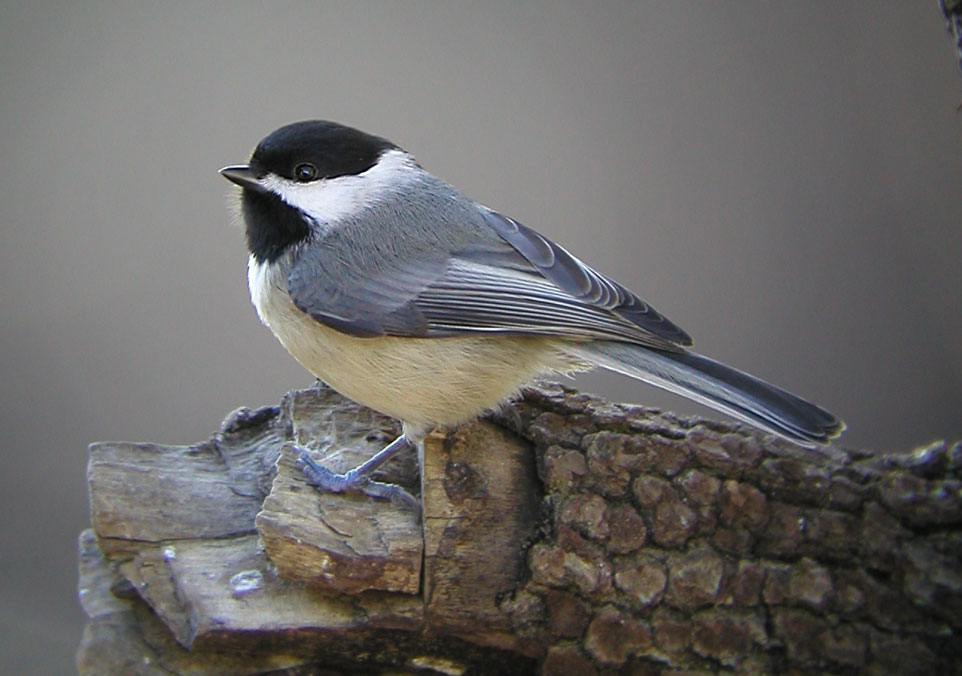
Black Capped or Carolina Chickadee?
I am participating in Project Feederwatch and as I looked through the documentation, the compiler emphasized some of the common misidentifications that occur in Indiana - one being the chickadees. So, I did a little research and found a wonderful site describing the differences and trying to help in distinguising between Carolina chickadee and Black-capped chickadee.
So, I read these clues and got out my Sibley Guide and read all the information on telling the two species apart. Evidently, I have been guilty of naming the chickadees I've seen locally incorrectly. After careful review and study, it appears the chickadees I see most often are indeed Carolina chickadees. Since I was a kid I have always referred to them as Black-capped. Actually, I still wasn't sure even after reading all the available resources and then I went to my birding software program and pulled both birds up side by side and noticed the differences in the cinnamon buff coloring. The chickadees that I observed in the yard match the plumage markings of the Carolina chickadee in the software almost exactly. Now, I find myself wondering if I have ever truly seen a Black-capped chickadee or have misidentified every one I've seen for all these years!
On the subject of chickadees though, it sure seems to have been a good year for them as they are easily the most abundant bird in my yard this fall.

Success!
Moving the feeder at the house turned out to be a fantastic idea. The new location was quickly greeted by many more birds than we had previously. And yes, finally, we have Junco's! (Where have they been? It took them awhile to get here!) I saw one when I was out working on the deck feeding on the ground nowhere near the feeders. But later that afternoon, I spotted them right under the safflower feeder just like last year.
But, my favorite weekend visitor was one I had been trying to lure to the feeders all summer. The Red Bellied Woodpecker lives in a snag in the woods by the house. I see them flying overhead a lot during the summer but never had one come to the feeder station...UNTIL YESTERDAY! I used to get these guys at my feeders frequently where I used to live but in 9 months at this house, had not been able to get them here. I attribute this directly to the move of the feeders. Now if I could just get the Pileated to come to my suet feeder! I see a couple that live deeper in the woods that come to the edge periodically and feed off of some of the lower snags. Maybe they will grace us with their presence and I can get a picture. They are fairly common here but one still can't help but stop and marvel at these creatures when confronted with their size and presence.
The red shouldered hawk is still around in the woods. His calls were noticeable further back in the woods and I see him occasionally soaring over the neighborhood when I am coming home from work, but haven't seen him perched in his favorite tree in the back yard for a couple of weeks now. Too bad because I would love for him to catch the chipmunk that is hanging out in the flower beds munching on the lilly bulbs.

The first snow
Brrrr...Central Indiana had their first snow of the year yesterday. Oh none of it stuck to the ground, but snow showers were present throughout the day. This was followed by a cold front that had the Indiana thermometers plummeting to an unseasonable temperature in the low 20's.
There are still no signs of juncos at the house yet. Talked to a lady at work who said she has had juncos at her feeder since late October. What did arrive behind the most recent cold front was a horde of house sparrows. I had not seen that many house sparrows so far at this house but there are tons of them here now. I was reminded of the fact that, although abundant here, and often considered a nuisance bird for occupying bluebird nests, house sparrows are an endangered species in some parts of the world. In fact, one was recently killed for toppling dominos in the Netherlands which will probably result in prosecution.
I don't mind the house sparrows so much - I like them better than starlings! But isn't it funny how some birds get a bad rap. How our value system places one species more desirable than another? I try not to be like that, particularly in birding and try to stop myself from comments like, "Oh, it's just a Robin", or "It's only a house finch", or even, "Nothing there except Canada Geese." Shouldn't we embrace all birds of all species for the gifts they give us, whether common or not?

Moving the Feeder
While watching the feeders in my alone time on Sunday, it occurred to me that for the winter birds, it makes sense to relocate my feeders to the front or side of my yard where they will be better protected from wind and they also will be more near cover. Hopefully this would serve two purposes. First, being near cover will increase the opportunity for the less brazen birds to come to the feeders. Secondly, maybe the birds I see on the side of the house that never come to the feeders in my back yard, will come to them if relocated, thereby enahancing my birding pleasure!! Now the hard part...where to move them?
Doing a little research on the subject has not really helped me learn anything I didn't already know. None of the articles seem to address my biggest issue! Where can I put it so I don't have to rearrange all the furniture in my living room? Let's face it! This is a dilemma. LOL.
All joking aside, I have trouble visualizing these sorts of things. I have made a drawing and what I decided on looks good on paper. But, will it translate to the "optimum birdfeeding experience"? The yard has a hill - not just a slight one but a fairly steep one. (I hate mowing that thing! - but I digress) Thinking of walking on the hillside in a foot of snow is certainly not a pleasant thought. I'd love to see pictures if anyone has any ideas on how to place birding stations on hillsides.
There are mice in my basement. First they attacked the birdseed. I secured all of that, but I forgot about the suet cakes on the shelf. The little varmints bit a hole through the plastic and ate a piece out of them! This is war! If they aren't careful, I'll release the cats down there! :-)

Winter birding in the midwest - what's one to do?
I start to feel this way every November, usually about 2 weeks before Thanksgiving. Most of the fall migrants have passed through for the season, the leaves are almost all gone from the trees, the wind blows with a little more bite than it had last month. Winter birding season - UGH!
Usually in winter, I do a lot of waterfowl birding - at least until the lakes freeze over in January. Also, here in Indiana, going to Jasper-Pulaski Fish and Wildlife Area is a must see to witness thousands of migrating sand hill cranes. I have gone every year for several years and I still get the feeling of exhilaration as I walk from the parking lot to the viewing platform and hear the piercing sounds of their cooing and cackling. Then to get to the platform and look out at the thousands of birds is truly an awe inspiring experience.
The days get colder and darker during December. Of course there are always visitors to the feeder stations in the yard, but the variety of species is so much smaller. Last winter I read a book called "Birds of Winter" and it talked about using the winter to really study the behavior habits of birds and to practice looking for distinctive markings on each bird and trying to pick up on subleties within the species. So, that is one goal I have for this year to alleviate the normal winter birding doldrums.
Another winter activity that I am going to participate in this year is the 106th annual Christmas Bird Count. Many birders participate every year and make it an annual event! I've only done this by myself in the past, but this year, I have an accomplice! (Thanks, Kat!) We are just now in the planning phase but I am looking forward to making this the most fun holiday tradition in which I partake. Certainly, it will be the most anticipated.
January and February will be the times for studying the birds and trying to identify their unique characteristics. The weather here can be pretty ugly this time of year. But, for dreamers out there, with the necesary financial resources, there is a Winter Bird Festival in Morro Bay, CA. No way I can afford to go this year, but, hey, it's good to know there are options for us folks stuck in the dead of winter!

Are bluebirds wintering at my house?
When I saw the pair of bluebirds in my back yard over the weekend, I couldn't help but wonder if they were going to winter at my house. Their behavior was more of scouting in nature rather than just feeding. Not really being familiar with Bluebird migration, I decided to do a little research and it appears that they are not necessarily heavy migrants. In fact, it appears that Bluebirds migrate little in areas of mild climate and seem to only venture as far southward as needed in order to find abundant food.
I remember when first moving to this house, as I was watching the movers unload the truck, a couple of bluebirds were sitting on the driveway. This was early March and I can't help but wonder if these little guys I saw Saturday are the same ones that spent the spring in my woods. Maybe they will migrate southward to warmer areas once the snow hits, or maybe they'll be content foraging on the berries in the woods and supplement their diet with the seed smorgasboard at my feeders!

Sunday was a blustery day in Indiana - during the night Saturday at 3 AM I was awakened by a huge thunderstorm and howling winds. I hoped it would stop by daylight so I could see what might arrive behind the front at the woods in the back of my house. I was not disappointed. As I got out of the car after returning from the hardware store, the trees were filled with bird song. I grabbed the bino's and was immediately blessed with a flock of cedar waxwings swaying in the windy treetops. I counted 9 of them. Then I scoured the trees for other newbies. A pair of eastern bluebirds actuall came to my feeder! One sat on top while the other ate safflower. I saw tons of starlings and of course the winter finches had arrived. I saw one Common Redpoll - a first for my yard list! There were the usual suspects, crows, blue jays, cardinals, goldfinches, housefinches, house sparrows, a couple of downy woody's and a pileated. By this time I had to finally go and unload the car. Still no juncos at my place yet!

A Fresh Start
Trying a new twist on my old blog, one that addresses more of my interests and gives us more to write about and talk about. Wish me luck!
The indigo bunting - one of my favorite birds! I remember being serenaded by one last year at Conner Prairie. He was on a limb directly overhead and continually sang his song over and over while I was eating an ice cream cone. They say the male indigo bunting mates with up to 30 males in the breeding season! Quite a virile bird! One after my own heart! LOL

